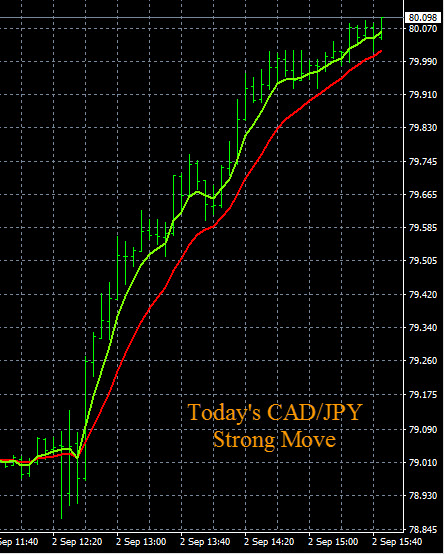
Introduction
Multiple time frame analysis of the spot forex is by
far the most thorough method of analyzing a currency pair. It takes time and
effort and this goes against what most forex traders want which is something
quick and easy. Most forex traders generally look at only one time frame. For
those of you who want to truly understand how the forex works its imperative to
be thorough when analyzing a currency pair and the overall market prior to
entering a trade and risking your money.
Multiple time frame analysis (MTFA) of the spot forex is completely
misunderstood and most forex traders are scared to try to learn it. MTFA is
also completely underutilized because it takes more work and most forex traders
are looking for shortcuts like forex robots or trading off of one time frame. A
handful of forex traders have mastered MTFA and the number of people who
utilize it is slowly growing due to the historical lack of success of forex
traders and the dangers of trading on only one time frame.
What
is Multiple Time Frame Analysis?
Multiple time frame analysis (MTFA)
is the inspection of very basic forex trend indicators and forex charts,
starting with the largest trends and time frames, and working backwards down
through successively smaller time frames to see how the smaller time frames and
trends feed the larger time frames. When the smaller time frames are in agreement
with the larger trends you can enter a spot forex trade in the direction of the
trend with very good safety. If no trend exists on a particular currency pair
the smaller time frames and trends will, at some point, build an uptrend or
downtrend. MTFA is completely logical.
The principles of multiple time frame
analysis are also fairly simple and if used daily will help you to learn forex
trading and have a complete grasp of the forex market. When using multiple
time frame analysis the smaller trends are used to enter the larger trends, if a
trend is available, or to observe how the larger trends are built from
the smaller time frames. If a larger trend is currently established on a
particular currency pair you would enter the trade when the smaller trends and
time frames are in agreement with the larger trends, The smaller time frames
confirm the continuation of the established trend.
MTFA has been around for nearly 30
years. The MTFA method is applicable to stock and commodities trading, equity
options and currency options, and now forex trading. The method is applicable
to any currency pair. We are respectful of the strong technical work of Kathy
Lien and Brian Shannon outlining MTFA principles and links to their their
technical papers are available at the bottom of this article
Mechanics
of Multiple Time Frame Analysis
Multiple time frame analysis is
conducted as follows. You take a set of simple trend indicators and forex
charts and install them on a forex charting platform. Then start with the
largest time frame available on the charting platform and “drill down” the
charts to the smaller time frames in descending order on one currency pair.
In order to conduct and accomplish a
multiple time frame analysis on the spot forex you need the proper forex
charting platform and a set of trend analysis tools and indicators to
facilitate the process. Some forex charting tools and platforms are very
expensive but many are free. This is discussed in detail below.
How many time frames must be examined on each currency pair??
Based on experience about 8-10 time frames is enough but about 10-15 is much
better. You can drill down the charts on the top 15-20 traded currency pairs to
seek out the best opportunity.
What is the correct number of time frames that must be in agreement to enter a
trade?? Based on experience about 3 time frames is enough if you know the
direction of the primary trend on the larger time frames.
The first step when conducting a MTFA on a currency
pair is to inspect the largest two or three time frames and trends on one
currency pair or several pairs you may be interested in trading. See what
currency pairs have established larger trends, then see whether the trending
pairs are at the beginning, middle or deep into the trend.
Also determine which pairs are not trending on the larger time frames, any
currency pair that is not trending is likely oscillating or ranging up
and down between support and resistance. These pairs could be developing a new
directional trend at some point or within a few days.
What
to Observe When Drilling Down The Charts
Every time frame has its own
structure and is independent of the other time frames. The higher time frames
trends and the direction of the major trend always overrule the lower time
frames. The prices in the lower time frames tend to respect the energy points
(support and resistance points) of the higher time frame structure. The support
and resistance areas in the higher time frame can be validated by the action of
lower time periods.
One time frame may appear to be
chaotic and have its own structure, then the next time frame appears to be
smoother cycles and much easier to trade, in this case you would trade the
smooth time frame because this is what defines the market condition right now
and is easy to read. New trends in the smaller time frames enable us to enter
the trends in the larger time frames if a currency pair is trending. MTFA will
also quickly determine if a currency pair is not trending on the larger
time frames and then verify if the pair is oscillating or ranging between
support and resistance on the smaller ones. If a currency pair is not trending,
oscillating, or somewhat chaotic at some point the pair will start to trend and
the trend will always start on the smaller time frames on the left as the pair
breaks out of its range.
The “drilling down the charts”
process enables us to identify the smaller trends which feed the larger trends.
It will always let us know whether or not a larger trend is starting or is
already established. If a currency pair is deep into its trend or movement,
MTFA still works but the risk/reward profile of a new entry changes because the
trend may be nearing the end of this move. But once again MTFA will keep you
informed of this. Trading off of one time frame will never give you any of this
information.
If a currency pair is in an uptrend
on the larger time frames and sells off against the uptrend you can use the
smaller time frames to detect this and then subsequently re-enter the larger
uptrend. This form of trend trading is one of the safest methods available of
trading the forex. The currency pair sells off against the primary trend
establishes a relative low and then reverses back up into the trend. This can
also be done when a currency pair moves up against a larger downtrend. Multiple
time frame analysis facilitates this but looking at one time frame the trader
would be totally ignorant of this low risk trading opportunity.
To summarize MTFA, you navigate to
your charting platform and start with largest time frame and "drill down
the charts" looking for the trends, oscillations and ranges, choppiness,
orderly and smooth movements and chaotic movements and you observe them. You
are looking for smooth time frames and trading cycles that are easier to
identify visually. If you believe that the market is choppy this should be
noted because you will have a higher probability of stop outs on entries into
these choppy markets especially if your stops are pretty tight.
Remember smaller time frames feed the
larger time frames. The smaller time frames can be observed in a non trending
market as larger trends are slowly built day by day. If the larger
time frames are not trending the smaller time frames are most likely ranging or
oscillating. If the larger time frames indicate a trend you will know if you are
early or late in the trend cycle. MTFA completely strips down a currency pair
so you have deep knowledge of its behavior.
Most forex trading platforms and
forex charting systems are not properly designed for MTFA and have a fixed
number of time frames that you can work with. Most or all forex charting systems
are set up with totally arbitrary time frames with no logic path whatsoever and
are totally deficient for MTFA. The reason for this is that the forex
industry and the majority of forex traders have not accepted multiple time frame
analysis. Therefore the analysis tools that we are provided with reflect this
ignorance and these analysis tools are mostly deficient. So for now we are
stuck with these forex charting systems so lets review them now and make the
best of what the forex industry and software companies have given us.
Here are two forex charting platforms and their associated time frames. The top
charting platform with the arrows is expensive and has 7 different time frames.
The 7 time frames are interchangeable so you can add additional groups of 7 more
preset time frames so that analysis of 14 or 21 time frames is possible quickly.
The tool allows for quick navigation through the time frames by simply clicking on the red and green lights but cost is a
limitation on this charting package.
Here is the forex trading software
and forex charts platform known as Metatrader. Metatrader has 9 fixed
arbitrary time frames but the time frames are not customizable. This platform is
"adequate" for multiple time frame analysis but about 5 or 6 more
time frames would be much more than adequate, especially if the time frames were
adjustable and not arbitrary. The limitation on this charting package is the
number of fixed time frames but cost is not a limitation, it is free via most
forex brokers if you open a live or demo forex trading account. Metatrader
platforms also include desktop price alarms that are built in, another added
plus. The time frames are highlighted in blue.
The
chart portion of this image is an example of what one chart
on one time frame looks like on Metatrader. This example is an M15 time
frame or
M15 chart, which is 15 minutes per green vertical bar. The red and green
lines
are a very simple set of trend indicators and the instructions for
setting up
these trend indicators across all 9 time frames is listed at the bottom
of this article with all of the other links. You can use off the shelf
trend indicators to
conduct multiple time frame analysis. Simple indicators like these
exponential
moving averages are fine. Just apply them across multiple time frames
and this
is what they will look like. You will learn to trade the forex and
improve your
trading substantially with MTFA.
There are other charting platforms available to forex traders and some high end
platforms available from forex brokers that have adjustable time frames. These
moving averages and simple trend indicators can be set up on these high end
platforms provided by some brokers. We applaud the forex industry and some
forex brokers in this area as providing access to better charting systems
facilitates more forex traders using MTFA which can only benefit all forex
traders.
Additional Thoughts on MTFA
Is it possible to make multiple time frame analysis better??
I believe the answer is yes. Incorporating parallel and inverse analysis into
the analysis as well as support and resistance to set price alarms for
notification of momentum or a possible entry point can all help.
Incorporation of Parallel and Inverse Pairs
In other words if you would like
to conduct an analysis of various trends and time frames on the USD/CHF for
example, then you would conduct a MTFA of this pair but you would also need to
conduct the same MTFA across the same time frames for at least two more USD
pairs at a minimum, like the EUR/USD and GBP/USD. Then you could determine with
alot more confidence if there is consistency and agreement between the three
pairs, i.e. consistent USD strength or weakness across all three pairs.
Alternatively if there is no consistency with the USD you could also conduct a
MTFA of the GBP/CHF and EUR/CHF looking for consistent trends based on CHF
strength or weakness.
Then you would know for sure that the USD/CHF is trending, oscillating and
ranging, or choppy and you would also know why, then you have done the analysis
of the USD/CHF correctly and thoroughly. This exact analysis method can be
applied to any currency pair.
Most forex traders will not do this and most forex traders are not thorough.
Traders need to see that it is their money at stake so they had better get used
to being thorough from now on. The charts are right there start looking at them
and take pride in being thorough.
Scalpers may find MTFA to be to
their liking because they would be aware and never trade against the larger
trends and potentially hang onto trades much longer. One of the biggest reasons
people scalp is that they have no idea which direction the trend is on the pair
they want to trade. Or they only look at one time frame. Traders scalp the
foreign exchange but statistics show that people who hang on longer and ride
longer trends make the most pips. All forex traders benefit from MTFA.
Why do traders not use multiple
time frame analysis? Mostly because analyzing alot of pairs and time frames takes
time and people basically are lazy. They are looking for the next big thing in
the forex when the answer is right in front of them. Looking at one forex chart
is all they want to do. Most scalpers only look at one time frame and could
possibly be trading against a larger trend, or a scalper may be trading at the
beginning of a very large move and exit way too early. If you are near the end
of a trend you may also enter a trade after a long move and be entering near
the end of the trend. This is poor money management under any scenario.
Scalpers need MTFA but traders who would like to stay in their trades longer
and ride the trend would, by nature require knowledge of MTFA.
MTFA works, it is that simple. Pips
can be made and a more thorough analysis of any currency pair is possible and
the method is effective, especially when larger time frames and trends are
traded for larger pip totals. Money management ratios also improve when you are
entering a larger trend. By applying MTFA to multiple forex pairs in the same
parallel or inverse group of pairs your odds increase again, this is because
you can choose to trade the best and largest trend available in the spot forex
and ride the trends longer. The more pairs you analyze, the more potential pips
there are, so there is a payoff for your time and effort.
MTFA analysis of the spot forex is
here to stay. Traders worldwide are starting to accept and learning to
understand the multiple time frame analysis method and abandoning trading on one
time frame due to the additional entry risk and past monetary losses. MTFA is a
rigorous method or analyzing the forex. But it is not difficult to learn. When
combined with parallel and inverse analysis is quite powerful and can lead to
high probability trading plans and trade entries. It can be applied to any
currency pair using simple, free trend indicators and analysis tools available
on the internet from many spot forex brokers. Instructions on how to set up
these simple forex trend indicators are at the bottom of this article.
When
the Analysis is Finished What Will I Know ?
After a forex trader has completed
analyzing the market with MTFA he or she will know if the currency pairs
examined are trending, oscillating or ranging, or have smooth or choppy trading
cycles. The trader will also know if the behavior of the pair has adequate pip
potential to consider a trade or putting together a trading plan.
If you follow the rigorous rules in
this article for conducting MTFA you will also know which parallel or inverse
pairs in the same individual currency groups are also trending, which increases
your odds tremendously of making the correct analysis and subsequent trade plan
or entry.
You will not be ignorant of the
larger trends if there is one in place. MTFA should have a profound impact
on any forex trader who discovers it. Knowing if a pair is trending or not
would be an immediate criteria for a trader to trade or not trade and his or
her trading results would start to improve just by glancing at the larger
trends. The impact would be positive and immediate and you would start to develop
criteria for preparing trading plans while learning the behavior of currency
pairs.
Okay you have sold me. I believe in
multiple time frame analysis. I have analyzed currency pairs with MTFA, I have
found a currency pair in a nice uptrend, the parallel and inverse pairs all
verify the direction, what do I do now?? How do I enter the trend??
You are almost ready to trade. You
have identified a pair and it is trending, you need an entry plan. The pair you
are interested in general will have a nearby support and resistance point. In
this case the pair you have identified is in an uptrend so you can look for the
next resistance point. Now just go to your forex charting platform and set a
price alarm at the next resistance area to intercept the next move. When the
price alarm hits check the smaller time frames to see if they are in agreement
with the larger trends, as outlined in your MTFA setup, and if all of the
trends are in agreement enter the trade.
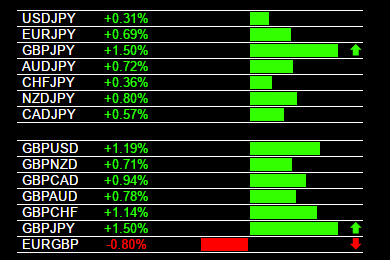
As a final step before entry check
this visual map of the spot forex called The Forex Heatmap ®
The Forex Heatmap® is a visual
map of the spot forex to verify all of your trade entries. The step by step
guide to using The Forex Heatmap® is included in this article in the links at
the bottom of the page. Now you can verify your entry into the trend. In this
example above you have a buy signal for the GBP/CHF.
Now you are ready to trade the spot forex, you analyzed the market thoroughly
across multiple time frames and multiple pairs. You determined the trend on a
pair, you analyzed multiple parallel and inverse pairs to verify the high
probability of the move on the pair, you have set a price alarm to intercept
the move, and you checked The Forex Heatmap (tm) entry verification system to
verify your trade entry. You are a thorough and accurate forex trader and are
now in a position to win on every trade while other traders continue to
struggle scalping with indicators on one time frame.
As I stated above there are some high quality charting platforms that work well
with multiple time frame analysis. There needs to be more improvements in forex
charting platforms with more time frames that fully adjustable by the end user
so you are not stuck with fixed forex industry time frames like H1, H4, etc.
which decrease the value of MTFA and handcuff forex traders somewhat. More and
more traders will demand charts like this or take their business to another
forex broker.
The acceptance rate of multiple
time frame analysis is slowly growing and the dangers and risks of trading from
one time frame are slowly being revealed to forex traders who will want better
trading tools. Forex traders will go with the brokers who have the best tools
and move their money elsewhere.
At this time multiple time frame
analysis is visual and must be done manually with a lot of computer keystrokes
and it does take some time. As you get better at it the process goes much
faster. In the future MTFA could be done differently and a computerized system
of MTFA using advanced forex trading software where the analysis is conducted
by a computer that models the data and conducts linear and nonlinear regression
for each time frame with least squares analysis. The program would
"optimize" a set of at least three time frames for each pair with the
lowest standard deviation or highest degree of smoothness for each of the three
time frames for that particular currency pair. The computer program would then
print out the customized time frames for the trader to set up and watch. This is
a vision of computer analysis of the spot forex that I believe will at some
point be accomplished.
Three
Articles on Multiple Time Frame Analysis
My personal journey through multiple
time frame analysis started when I was reading stocks and commodities magazine
and came across Kathy Liens article. In order to understand the principles of
multiple time frame analysis you can consult her technical article titled
“Trading Currencies Using Multiple Time Frame's” by Kathy Lien and Patrick
Dyess. For a reprint of Kathy Liens article click on the links at the bottom of
this article.
I was immediately impacted by Ms.
Liens work and I knew that the red and green light software, which had only 4
lights at the time and was the charting platform I was using at the time, was a
charting package that needed to be improved upon and at that the software was
actually a tool for MTFA, and now everyone else knows this.
Nobody I worked with understood this
software and charting platform and I made it my mission to understand it and to
try to be the best at applying this platform to multiple time frame analysis.
This evolved into the “Big Lights” method of multiple time frame analysis, and I
subsequently put together a set of free trend indicators for multiple time frame
analysis on my website that were developed with assistance from others. A link
to the free trend indicators for multiple time frame analysis that I have
developed are also at the bottom of this article.
Also there is a link to an excellent
article on multiple time frame analysis by Mr. Bryan Shannon at the bottom of
this article. The Article is titled "Increase Your Odds With Multiple
Time Frame Analysis"
These two articles and the MTFA
method had so much of an impact on me that I wrote my own original article (this one) on
multiple time frame analysis with some new information that includes a
discussion of parallel and inverse analysis which could clearly enhance the basic MTFA methods.
Important
Links